


The Misconceptions about Occupational Qualifications and Higher Education Qualifications
By now we should all know that there are three (3) main Quality Assurance Bodies Governing Learning and Education within South Africa.

Quality Assurance Bodies and their Qualifications
Both the Bodies namely, the QCTO and the CHE discussed in this Article, serve critical roles in equipping the Workforce with the needed Skills and Knowledge, only in different ways.
This Article identifies the primary differences between the Qualifications of these Bodies.
The two Types of Qualifications addressed in the Article.

QCTO: Purpose of a Curriculum
The purpose of a Curriculum in South Africa as per the QCTO is to ensure that Training is responsive to Industry needs, thus the QCTO’s Curriculum is designed to help Learners develop the Skills they need to be Employable.
The QCTO’s Curriculum aims to –
- Develop Occupational Qualifications meeting Labour Market needs.
- Create credible Qualifications that are Nationally and Internationally recognized.
- Help Learners gain Skills that are in demand and have Economic Value.
- Make it easier for Learners to find Employment.
CHE: COUNCIL ON HIGHER EDUCATION
The Workplace itself cannot directly Train and Award a Formal, Accredited CHE Qualification; only an Accredited Higher Education Institution (HEI) can Award such a Qualification.
A breakdown of HOW the Workplace, CHE and the QCTO interact regarding Qualifications:
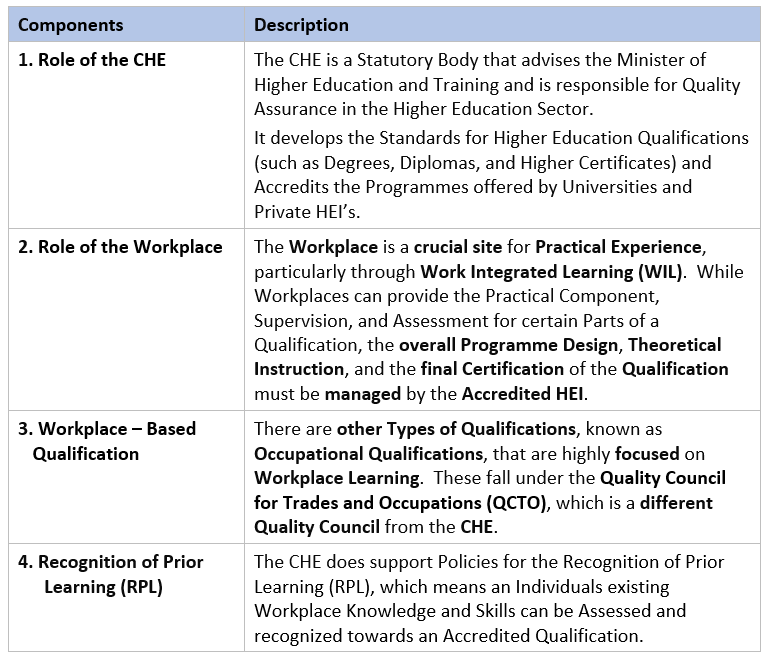
In conclusion, a Workplace can facilitate Practical Learning and Experience, which contributes to a CHE – aligned Qualification, but the Formal Qualification itself is awarded by a CHE – Accredited Institution.
Key Distinct Features between these Qualifications:
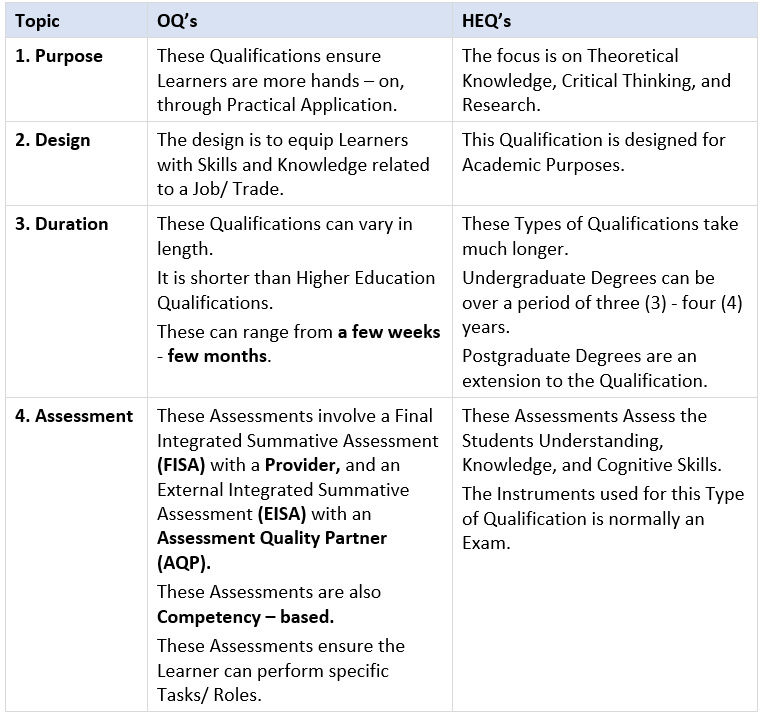
Benefits of the two Qualifications:

Summary
The QCTO works with Industry Experts, Skills Development Providers, SETAs, TVET Colleges, and Employers to ensure Curriculums meet the needs of the Labour Market.
Both these Qualifications have Value to add within Society and the Workplace. The only difference will be, the Opportunities and circumstances the Individual was exposed to. Both these Paths can lead to Career Opportunities within the Market Place. Occupational Qualifications offer a direct Pathway to an Occupation for the Individual, while Academic Qualifications provide a wider base for Professional Pathways and Opportunities.

Leave A Comment